Deep Within? What are we actually talking about when we talk about viscera?
Lecture by Jaap van der Wal—embryologist, physician, and phenomenologist—delivered at the Osteopathy Conference Innovations and Insights into the Visceral System in Osteopathy, on September 18, 2026. On this page, the lecture is presented in a comprehensive web layout, with the original slides displayed alongside the accompanying text.

Just to clarify: I will be referring to a number of articles. The PowerPoint presentation that you have received—or will receive—from the conference organizers contains links to those articles and to my website, www.embryo.nl. They are always available in three languages.
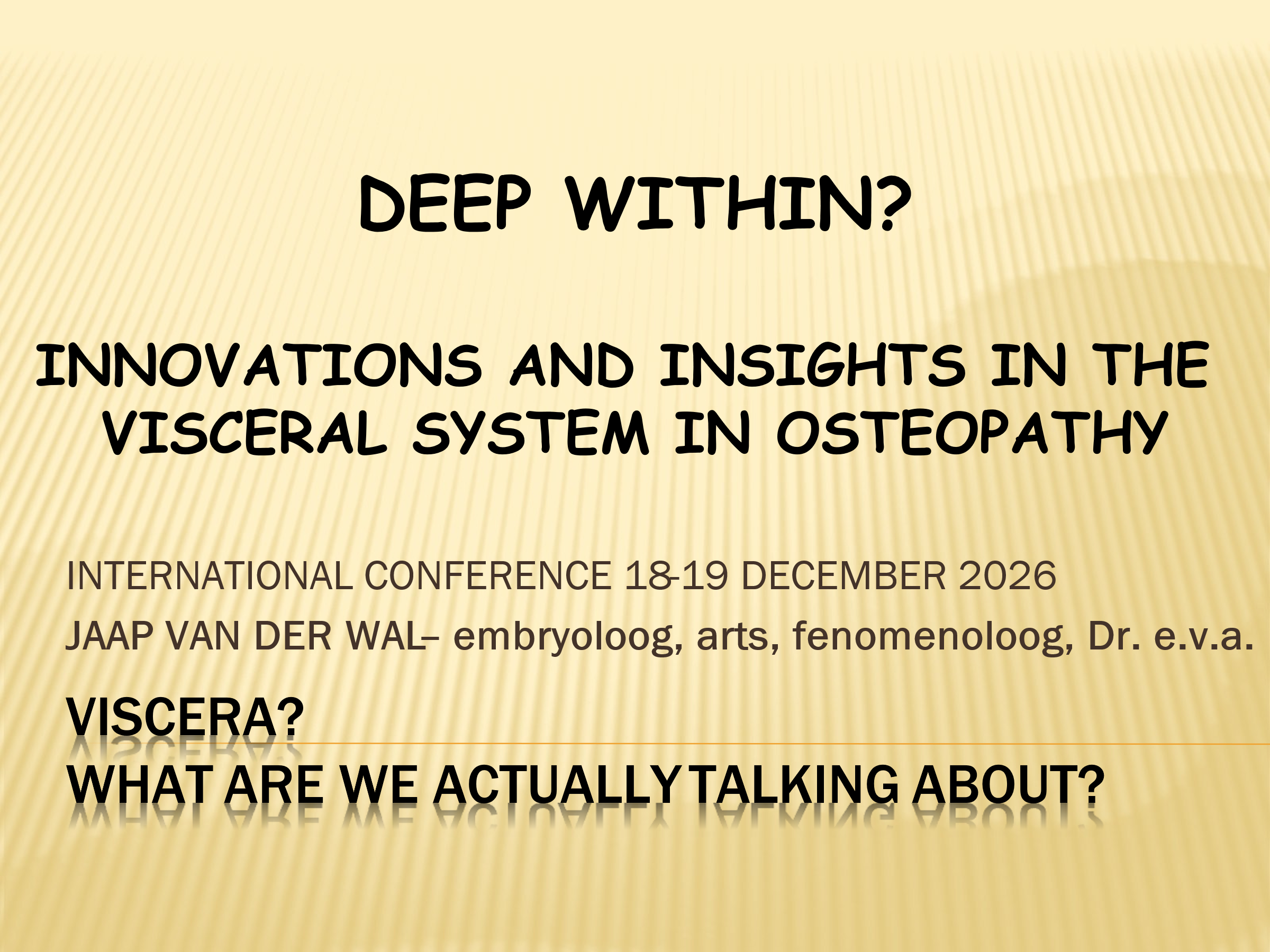
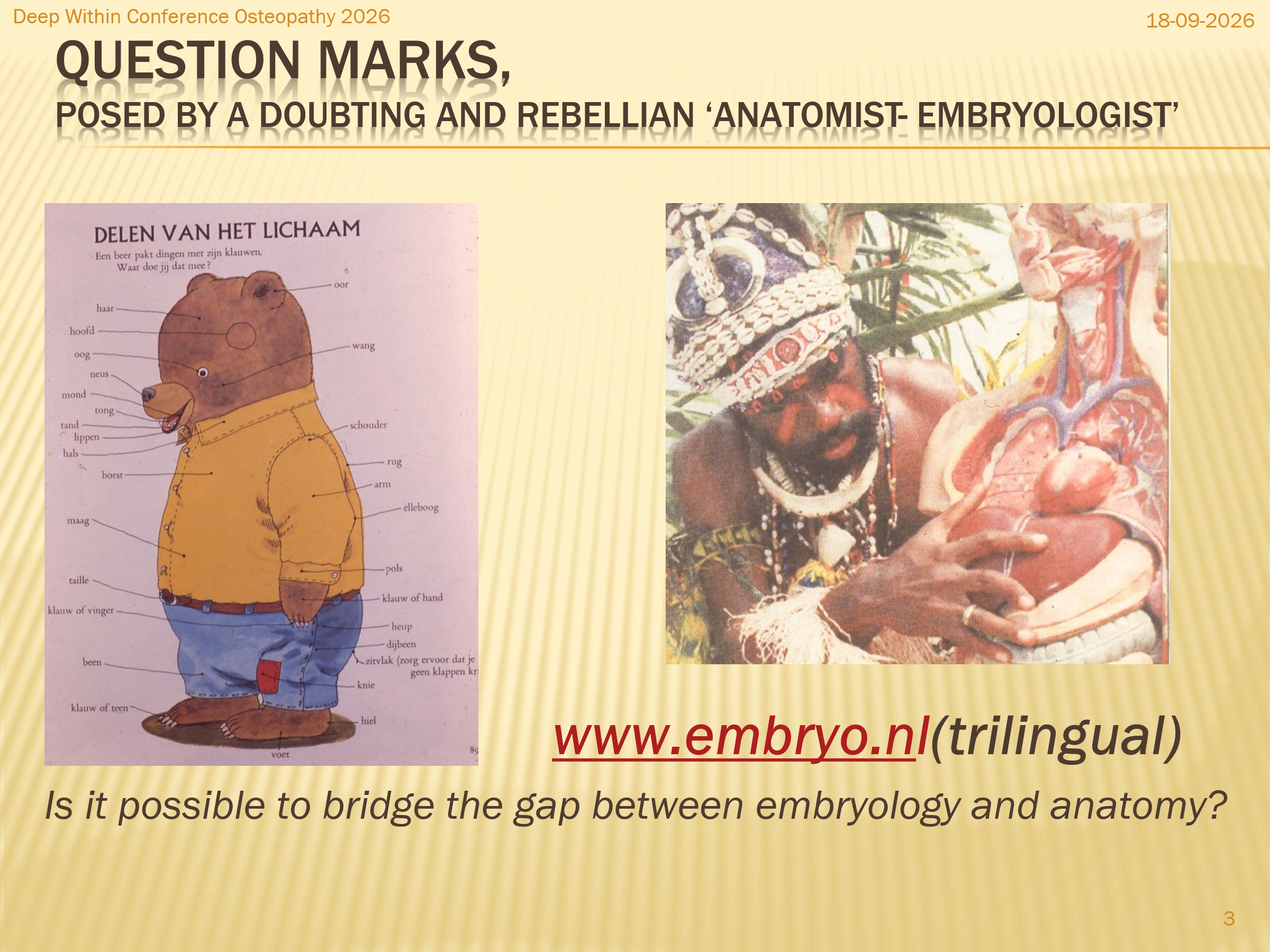 QUESTION MARKS
In medically oriented symposia, anatomy is often given the first word. After all, anatomy remains the foundation in the medical field: that’s where we always begin. Yet I am frequently confronted with the prejudice that “anatomy is now sufficiently well understood; surely there’s nothing new left to add.” Well, then you’ve come to the wrong place with this rebellious anatomist. Reductionist mainstream anatomy is in urgent need of broadening the view and of complementarity. My contribution to 21st-century anatomy is the development of a “phenomenological anatomy”. So, fasten your seatbelts.
 LOST MORTALITY
I am, in a sense, an anatomist against my will. Classical Vesalian anatomy has turned out to be a half-truth. It ultimately led to the modern dogma or paradigm that a human being is “nothing “but” his/her physical substrate. Everything that could be attributed to ‘soul or spirit’ in past centuries has been lost in the modern reductionist “nothing-but-ism” of neurogenetic determinism. In my view, we’ve lost something along the way due to anatomy. Our body has become an inanimate substrate, and our mind has degenerated into the brain as story-telling chatterbox. We are no longer a stereo of mind and body, and of “soul” and “spirit”; all that remains is that multi-interpretable concept of “mind”—a sort of catch-all term for consciousness, spirit, neural circuitry, and the brain.

IN BETWEEN
Here you see me positioned between two symbols of those scientific fields I am expected to represent. To my right is a cabinet containing skulls, and to my left is a diagram of the human embryo that I drew by hand. In my right ear, I constantly hear the message of the “building-block doctrine” paradigm that came along with the anatomical mindset. For 40 years, I taught this to medical students with great enthusiasm. I was even required to teach it. The anatomy instructor must teach that the human body is composed of the parts—the organs, the tissues (and even the cells)—into which he or she has analyzed the body. This analysis is theoretical and philosophical, based on the literal analysis of anatomical dissection. Taking apart, disturbing the continuity, separating, distinguishing, and thus arriving at the conclusion that the whole is composed of the parts. Anatomy textbooks and atlases are still organized according to this pattern. We start with the skeleton, add ligaments, muscles, and joints, then organs, blood vessels, nerves, a brain—and voilà: Jaap van der Wal. The building-block doctrine, however, no matter how convincingly presented, is NOT A FACT; it is an interpretation. There exists another way to look at it. That’s what the human embryo whispers into my left ear.
 START AS A CELL?
The embryo tells a completely different story. The other half of the truth? Anatomy is about being (what it looks like, how it’s put together); the embryo is about becoming. How, then, does the body come into being? Is it built up from elements? In the beginning, there is the zygote, which is still (and incorrectly!) referred to as “the fertilized egg” by the majority of human biologists. A single cell, then. And through a process of nearly endless multiplication, so is the main stream interpretation, that single cell gives rise to more and more cells, which organize themselves into organs, and thus the body—the whole—emerges from the parts: like every living being, the human is made up of cells. The centrifugal model. We stem from the zygote, stem from the body.
 TEDTALK
That’s not true. Or at least, it is one way to understand the embryo. There is another possibility to interpret. That zygote is not a cell. A cell is a particle of life, a part of a larger whole i.c. an organism. Well, the zygote is a whole; it is a single-celled human organism. That is how “life’ has begun (if it has begun?). As unicellular organisme, not with cells, Conception is a metamorphosis: from cell to organism, from particle to whole. An impressive example of misleading homology: the zygote resembles a cell but is not one. It is the single-celled human body. And starts to be divided, suborganized into cells, the zygote is a whole that breaks down into parts—cells. Those cells differentiate, and organs and tissues emerge, but the whole remains intact. In Cartesian terms, that whole is an imponderable entity, not tangible or measurably present, but, over time, the reality that holds the parts—the cells—together.

AUTOPOIESIS
Living beings are not merely anatomy in function. Living beings emerge over time. An organism—including our own body—is a process, growing, flourishing, and differentiating throughout a lifetime, and thereby emerging. An embryo is not a “not-yet-human” or an incomplete being. The frog does not emerge from the tadpole. The tadpole, too, is a frog—but in a tadpole-like way. And so the embryo taught me, that we do not come OUT of but THROUGH our bodies. “We are bees and our body is a honeycomb” says Rumi “We made the body, cell by cell we made it”. Every living being is autopoiesis; it brings itself into being and actively sustains itself, even when supposedly “fully grown.” I quote Holdrege: “We just need to thoughtfully follow the process itself, and we see everywhere in organic life “being-at-work. Once we realize the activity-nature of a developing organism, we can see that the mature organism is also being-at- work i.e. a process in time? Read more.
 NOT MACHINES
Anatomy destroys more than you may like, is my slogan. Anatomist create machinelike bodies. We are NOT machines. Machines are systems composed of elements, assembled (by a human or another machine). Once the construction is complete, the machine begins to function. Not so in biology. In its embryonic and evolutionary development, a given organism is functional, from the very beginning. As living beings, we are never “finished” so that we can begin to function. Organisms also do not wear out; they age. “Use it or lose it” is the principle. Are there perhaps two ways of being “spirit in a body”? And is your Triune Man a representation of that? On the one hand “Die leibschaffende Seele”—as it’s called in German—the agency that shapes and sustains the body (autopoiesis); on the other hand, the soul, the spirit that comes to consciousness and emergence through this body.?


ANATOMY OR MORPHOLOGY?
The so-called ‘Triune Man (human) is the fundamental principle of osteopathy (that’s how I understand it). Anatomy or Morphology? Before I met Osteopathy in my career I met the anthroposophy (Rudolf Steiner). Like osteopathy anthroposophy assumes that we not are merely physical beings, but that something ‘else’ manifests within us and through us, call it soul or mind. Anthroposophy also has a kind of “threefoldness” of the body as a central theme. Threefoldness for me is the logical consequence of the concept that humans as living beings are of spirit and body. Andrew Taylor Still summarizes it, in my view, as follows: Man (the human) is Mind, Motion, Matter. In this pattern motion apparently serves as interface between the spiritual—that is, the non-physical—and the physical or anatomical dimension. It became increasingly clear to me: if we are beings of spirit and body, then kind of threefoldness must necessarily be the manifestation of that reality.

 J.W. ROHEN TRIPARTITION OR THREEFOLDNESS?
Is “Triune” really a tripartition, a threefold division? Before you become aware, you’ll find yourself thinking in terms of parts and organs again. And… systems. And start to pose the question Where is soul or mind located? Is soul located in the body or happening in and through the body? Anthroposophists do tend to lean a bit towards tripartition anatomy. Rohen mentions for example the sensory-nervous system, the rhythmic system and the metabolic system. In my view threefoldness cannot be anatomy, but MUST be (process) morphology. A formative principle that permeates the entire body in all directions and domains. Later on in my career I met Polarity Medicine (Randolph Stone)—third time’s the charm isn’t it?—, and the I finally gained the enriching insight that it is not about a duality of mind and body, as I believe has been wrongly attributed to Descartes, but about polarity. Polarity is not duality; polarity is a unity of two and, as such, the absolute necessity of a trinity. What happens if you view mind and body as polarity? Polarity is inconceivable without a center, an “inter-esse,” an “In between.” So it’s not 1-2-3; it’s One, and from there the Two differentiates, and the poles create the Third (not three!)d. Not three systems or three instances of the same thing, but an entirely different principle. Mind and Body are One: It’s not either-or; it’s both-and, and more: it’s neither-nor.

 FROM ONE, TWO .. TO THREE
There is currently a great deal of commotion and excitement in the world of embryology. Enormous strides have been made in the creation of artificial embryos. The breakthrough was the ability to induce the gastrulation process—that is, the formation of the three-layered embryo—in humans during the third week of development. So far, extrauterine embryos have not been cultured beyond the two-week stage. The rather primitive ethical consideration was that in the third week, with organ formation, the possibility of a nervous system also arose, and with it, the potential for pain sensation. So, before the third week the embryo does not heave an innerness, no dimension of organs?
How do they create such an artificial embryo? These days, skin cells can be “reprogrammed” into stem cells. Those stem cells are placed together in a petri dish, along with certain so-called epigenetic factors and are then sort of centrifuged. The cells begin to stick together, forming a clump of cells that—initially to everyone’s surprise—begins to “gastrulate” into a three-layered embryo. And that’s the bare minimum needed to form a human body. See? We can do it, too. Implicitly, such procedures seem to confirm the assumption that the morula is composed of, the product of cells. And see, now we even can “make’ a trilaminar embryo’s. An unsuspecting osteopath might say: see, there’s the Triune Man. Nothing could be further from the truth.
 FORM POLE versus PROCESS POLE
In the embryology classes I have the privilege of teaching here, I demonstrate something different. This duality of mind and body —this polarity but therefore also this threefoldness—emerges across more than eight bodily dimensions. There isn’t here enough time here to explain and describe it all in detail. Ultimately the polarity and tripartition, also the Triune Man turn out to be not an anatomical or photographic principle, but a holographic one. Of course, there is an ‘outside’ and an ‘inside’ (with parietal and visceral), but even before that, there is also a craniosacral dimension and, preceding that, a dorsoventral bodily dimension. There is also head versus limbs, but the head is also the polarity of the pelvis. And there is always an ‘in between’. Soul and spirit seem to be able to be everywhere!|
BTW
For many people today, that last point is unacceptable. In the mainstream view of humanity, the brain is still the last refuge (hiding place) offered to the soul. The soul has been reduced to consciousness, and consciousness has been reduced to the head and thought; and so, today, the soul has been narrowed down to the brain and its neural connections. The condition for a matter (the brain) is confused with the matter itself (the soul), as often happens in reductionist mainstream biology. We come from the brain and no longer through the brain. Yet no one—absolutely no one—can demonstrate how a ponderable, material organ could possibly produce something as imponderable as mind or consciousness. Because soul, mind and consciousness are (entirely private) experiences, not objectively observable. They only are ‘reality’ in the primary body that we are, in the secondary body the body that we have, such qualities cannot exist, it is inanimate.
-

FROM ONE, TWO.. TO THE THIRD
So what about the three-layer structure of the third-week embryo? As long as the embryo has not differentiated into a three-layered germ disc, human existence, a human body, and a human organism are not possible. There are no human beings composed solely of epiblast and hypoblast (i.e., ectoderm and endoderm). This is valid for all animal or mammal life: there is Innerness: anatomically, physiologically and psychologically. As you undoubtedly know, the mesoderm is also necessary for being human. But a simple threepartion is a matter of anatomy, not a Triune Human.

GERM LAYERS ,BUILDING BLOCKS?
In the third week, a third layer—the
 THE INER TISSUE. FASCIA?
As embryological phenomenologist, I see something entirely different—and so did Blechschmidt. He said that you can indeed, and quite rightly, regard the epiblast and hypoblast (ectoderm and endoderm) as epithelium. Layers, boundary layers, limiting tissues. Walls! Between them, a completely different “third” dimension emerges: the Innegewebe. Inner tissue. Interiority, the center, the in-between. Medium. An interior bounded by two walls. The essential core of animal organization (note that the word *anima* also means “soul”) is that innerness of the meso. No meso, no inner, no animal. Mesoderm (“derm” means skin) is a nonsensical concept. Two layers, two walls, are enough; the third dimension—the middle—is something else. That is where our inner life comes from. Not mesoderm, but “meso”. This is mesenchyme, the intermediate, the mediating, the in-between. This is fascia, this is “fabric,” this is our inner self: cells, fibers, interstitium, and (do not forget!) blood (capillaries). Blood is ‘everywhereness’. That is what we need for soul?
 ‘FABRIC’ OF FABRICA?
I believe that the mesenchyme is the “fabric” and the inner of the body. I call it the fascia in broader sense. It is an inner matrix into which the organs are woven and embroidered and within which they find their environment and means of communication. It is through this fascia, this matrix, that the embryo organizes itself via all kinds of biochemical indicators and factors. Isn’t it remarkable that Andrew Taylor Still also does not localize the human soul (that would be typical anatomical thinking: the soul does not “reside” anywhere), but rather states “The soul of man, with all the streams of pure living water, seems to dwell in the fascia of his body“?
Vesalius and the anatomists gave us the *fabrica* (the factory, the building, the construct). That actually is the title of Vesalius’s first magnificent work: *De fabrica humani corporis*. And, of course, one can think through and analyze this from the conceptual perspective of “fascia in a broader sense.” Of course inner organs differentiate in the inner: Muscles, bones, heart and blood vessels, even a fascial system can be postulated and ‘constructed’. Last year, a group of die-hard anatomists within the Fascia Research Society defined fascia “in a narrower sense”: a fascial system of connective tissue layers and continuity throughout the body, with the functional capacity to connect and transmit force, as well as to create space through sliding and movement. And where was that published? In the *Journal of Anatomy*. Thus, within the musculoskeletal system, a “fascia man” now was conceived and constructed to stand between Vesalius’s “skeleton man” and “muscle man”. My slogan always was “The Vesalian ‘muscle man’ is an anatomical artifact”. So is the fascial system.

First and foremost, the fascia is our inner self, our innermost being. We all know that there must be something living within an animal that we recognize in ourselves as our inner self. And that inner self is not revealed on the dissection table; that inner self can only be experienced in an animated, living being. We have two bodies. The primary body of the first person—the reality that exists in my life—is the body with an inner self, with a soul. And that other reality, the secondary reality—the body of the third person—is that of the Körperwelten (body worlds) . And while one fits into the other, the reverse is not true. When we reduce our physicality to von Hagens’ anatomy, the soul must inevitably give way.
 PARIETAL AND VISCERAL
So, it is not your viscera that constitute the inner self or the inside. The average person always thinks that when you open up the body in the dissection room, you’re going from the outside to inside. That’s not the case. Our exterior—the ectoderm—has become, in addition to the nervous system and everything associated with it, the parietal domain or ‘outside’ (wall), that interacts with the outside world through perception and conscious action. And when you go inward, you pass through the inner realm and arrive at the other outer wall—and that is the viscera. Actually you go from the outside to another body wall, another outside, but anatomically on the inside. Embarrassing? The visceral domain where, through metabolism, we unconsciously and intimately interact with the outside world. That “inside,” is, in principle, something different from “innerness.” And within that morphological Inner, no one else can be there but you. It is the substrate for your inner Self, not synonymous. Interstitium, blood, everywhereness.
 MY INNER. FIRST PERSON REALITY
If, as an osteopath, you truly take as your starting point the mortal human being—soul and body—then you must also take Rumi’s words seriously: “Study me as much as you like; you will not know me, for I differ in a hundred ways from what you think you see in me. Place yourself behind my eyes and see me as I see myself, for I have chosen to dwell in a place you cannot see”.
For me visceral is a body domain, polarity of the parietal body (as explained above). The visceral system for my would be “the endoderm and all its derivates” (like liver and glands). Visceral system therefore is a morphological-physiological entity. Anatomically maybe to be categorized as inside or innermost (deep within) but not as Inner. If you consider all organs that are located ‘deep within’ then you deal with an anatomical category. I saw that (at least according to Google—and as you know, AI can make mistakes) in osteopathy, for example the urinary tract and gonads are also considered viscera. I wouldn’t classify them that way. For example, in “my” morphology, I think the kidneys are more ‘meso-linked’, the brains of our physiological Inner, rather than viscera. The Greeks considered everything below the diaphragm to be viscera (splanchnicus) and did not directly count the kidneys, heart, and lungs among them. After all, you also have to take into account where the viscera are located from the perspective of the Triune Man. Triunity is everywhere. The viscera in the pelvis are of a different order than those in the abdomen or those in the thorax. And there is also such a thing as the anterior intestine, the middle intestine, and the posterior intestine, again a threefoldness (this time a craniocaudal one)..
I hope I did not embarrass you too much with this more theoretical and philosophical reflection on the item of this conference. Fortunately, I found in the same Google text that an important nuance should be noted, namely “that in osteopathy, the visceral system is not a strictly defined anatomical organ category.”
Thank goodness—Triuness is not anatomy.
What I have told you is not an alternative for anatomy of to ‘replace’ it. Maybe it is just the other half truth.
Last but not least: The content of this lecture has been established without the aid of AI.
St Michielsgestel, 18 September 2026